First responders run toward danger every day. What happens when the real threat is what the job does over time — and no one has built a system to address it?
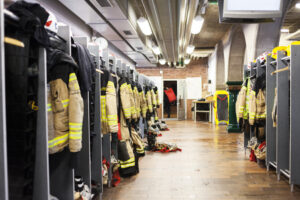
There is a version of this conversation that most people never have — the one that happens after the call is over, after the uniform comes off, after the door closes. The one where a firefighter or officer sits with something they cannot name and cannot put down. First responders are trained for the acute. They train for the fire, the scene, the crisis moment. What the training rarely addresses — and what the research now makes impossible to ignore — is the cumulative weight of everything that follows.What the data tells usThe statistics are striking not because they are dramatic, but because they have been hiding in plain sight for years. Depression and PTSD are up to 5 times more common among first responders than in the general population. In the United States, firefighters and law enforcement officers are statistically more likely to die by suicide than in the line of duty. Read that second point again slowly. The profession we associate most with physical danger has a greater internal risk than an external one. Yet our systems — the protocols, the culture, the resources — are built almost entirely around the external. This is not a morale problem or a weakness problem. It is a structural problem. And structural problems require structural solutions.Ready for the call Fire station gear lined up and waiting.The infrastructure gapIn 2025, the RAND Corporation published findings confirming what many within first responder agencies already suspected: there is no standardized wellness model across the field. Agencies operate with varying resources, disconnected programs, and no shared framework for measuring what works. Most agencies want to support their people. The intentions are real. But intention without infrastructure does not scale, replicate, or reach the officer or firefighter who most needs it at 2 a.m. on a Tuesday. The gap doesn't matter. The gap is architecture.
"Research without humanity is just data. We carry both." — Cummings Foundation for Behavioral Health
What evidence-based wellness actually looks likeAt the Cummings Foundation for Behavioral Health (CFBH), our work in first responder wellness is built around a five-dimensional model — one designed not for a brochure, but for implementation inside real agencies facing real constraints. The five dimensions are physical, addressing sleep, injury recovery, and overall readiness; mental, covering cognitive load, stress response, and access to clinical support; emotional, which encompasses trauma processing, peer connection, and relationship health; spiritual, focused on purpose, meaning, and identity beyond the badge or helmet; and nutritional, ensuring first responders can fuel their bodies effectively within the demands of shift-based, high-stress environments.These five dimensions are not treated as separate programs to be checked off. They are interdependent — and the model is designed to show agencies where their current resources fall short and where targeted support can have the most measurable impact.CFBH is currently piloting this framework with agencies, working alongside law enforcement leadership, fire departments, and higher education partners to build programs that can be standardized, evaluated, and replicated at scale.What this requires from all of usChanging the culture of first responder wellness requires more than better programming. It requires policymakers who treat behavioral health infrastructure as a public safety issue — because it is. It requires agency leadership willing to signal that seeking support is not a liability but a professional standard. And it requires researchers and practitioners willing to work in partnership rather than in parallel. The people who show up for our communities deserve systems that show up for them. Not after a crisis. As a baseline.Hope is not passive. It's a practice. For first responders, that practice has to be built into the structure of the work itself — not left to individuals to find on their own.

 What this requires from all of usChanging the culture of first responder wellness requires more than better programming. It requires policymakers who treat behavioral health infrastructure as a public safety issue — because it is. It requires agency leadership willing to signal that seeking support is not a liability but a professional standard. And it requires researchers and practitioners willing to work in partnership rather than in parallel. The people who show up for our communities deserve systems that show up for them. Not after a crisis. As a baseline. Hope is not passive. It's a practice. For first responders, that practice has to be built into the structure of the work itself — not left to individuals to find on their own.